
Last updated on November 20th, 2025
“When you walk the sands of Juno Beach, they walk with you”
by Carolyn Ray
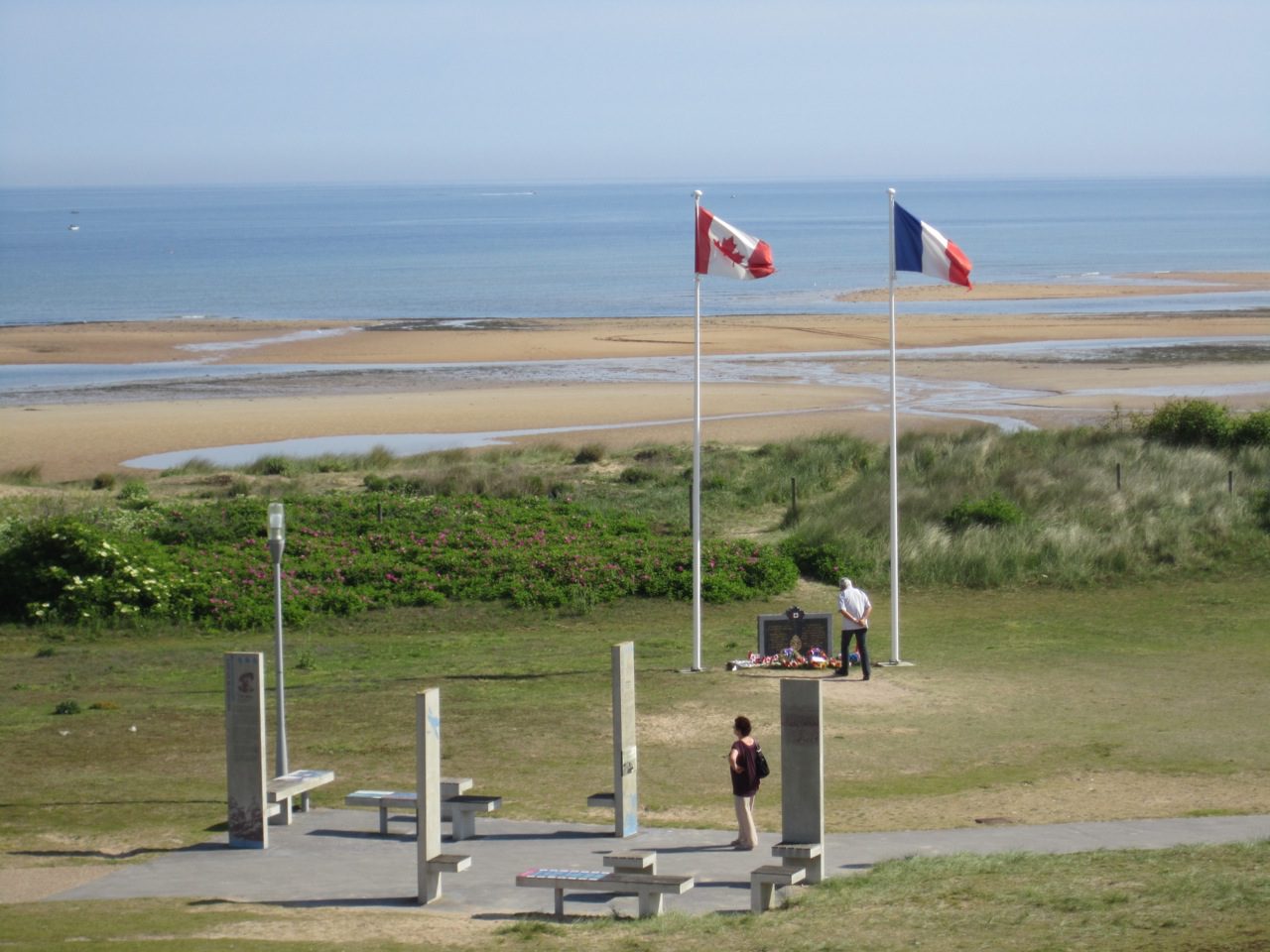
Along France’s Juno Beach in Normandy, France, 30 German bunkers date back to the 1940s. Connected by tunnels, these fortifications made this area impregnable — until D-Day on June 6, 1944. Known as Strongpoint 31 along the Atlantic Wall defence system, it’s now the home of the Juno Beach Centre, founded in honour of the 15,000 Canadians and 7,000 British troops that stormed this area, along with Allied Forces at Sword, Omaha, Utah and Gold Beaches on D-Day.
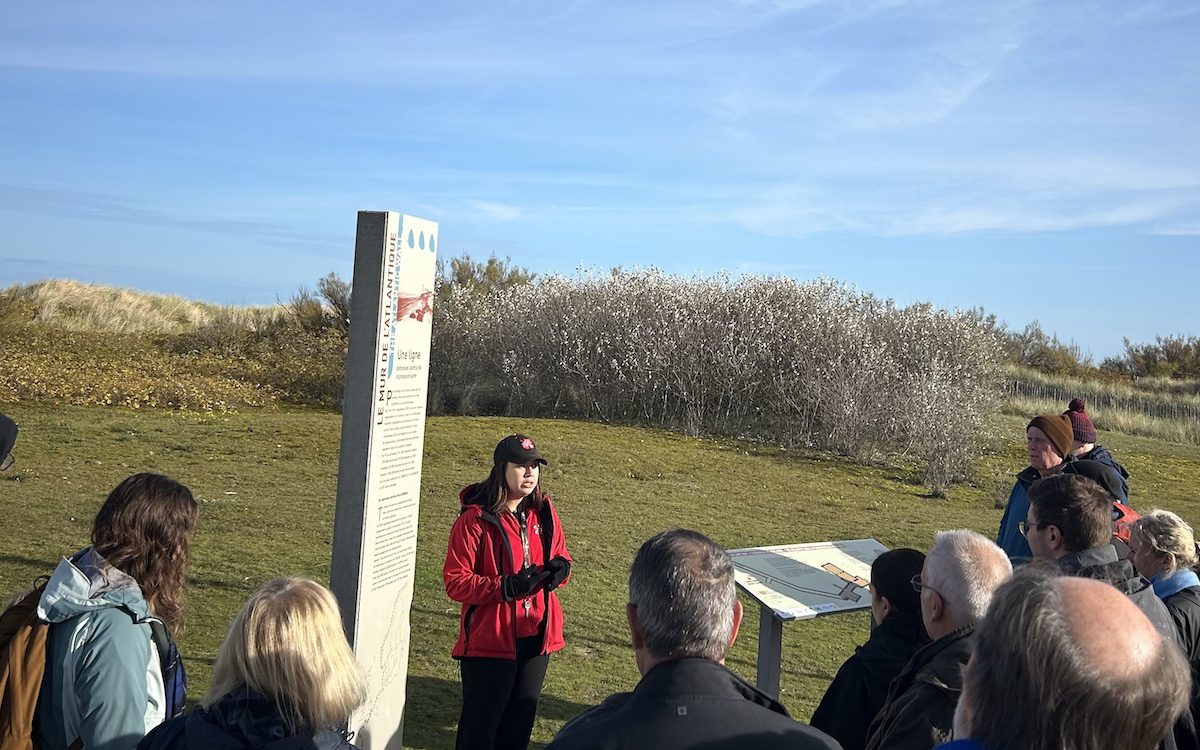
A few days before November 11, I join a group of tourists to explore the bunkers, guided by Kaitlyn Nguyen from Coquitlam, B.C. Some of them are above ground with machine-gun spotters to look for Allied troops, others are underground, stockpiled with weapons and two-metre-thick concrete walls to prevent attacks. Nguyen is one of 200 student guides who have worked here since 2003 as part of the student guide program, put in place by the founding veterans of the Juno Beach Centre. At 23, she is the same age as many of the soldiers who landed in Normandy in 1944, and it’s the last day of her seven-month program.
A living museum of stories for intergenerational learning
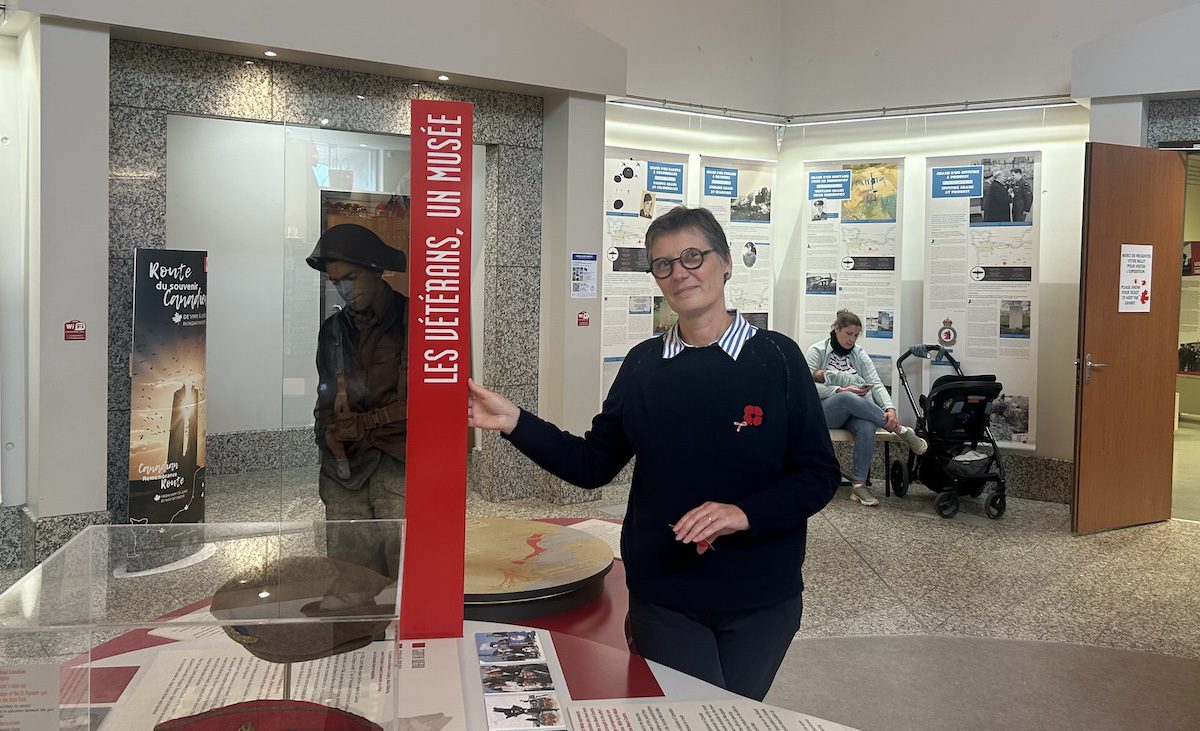
As we walk into the museum itself, I see families with young children, mothers with strollers and adults. Nathalie Worthington, Director of the Juno Beach Centre, hands me a card for the “Explore Juno as a Family” touchscreen game. The interactive quizzes make the historical content relevant to everyday life, especially for young people. The goal, she says, is to get 52,022 points, the number of Canadians who are buried in France from both the First and Second World Wars.
“The Centre is more than a museum, it’s a living link between generations,” Worthington says. “It’s also a way to correct misconceptions about Canada’s participation in the war. The world may know the Hollywood version of the war, but there is more to tell about Canada’s role. Our goal is to share the enduring bonds of service, sacrifice, and shared history. We see incredible potential in reaching those who value meaningful travel, history, and legacy.”
The Juno Beach Centre would not have been possible without the involvement of Canadian D-Day veteran Garth Webb. In 1994, on the 50th anniversary of the D-Day Landings, Canadian veterans, accompanied by the widows and children of veterans, returned to Juno Beach. At the time, there wasn’t a commemorative site recounting the significant Canadian contribution to the Second World War or a place to share the stories of Canadian veterans, Worthington says.
The Centre opened in 2003, with funding for the construction from Canadian citizens, the Canadian government, some provincial governments and the French government. Since then, the Centre has welcomed over 1.5 million visitors; one in four under age 18. Attendance continues to increase, and 30 per cent of the 100,000 visitors in 2024 were Canadian.
Canada entered the war in 1939, two years before the United States
One of the things I learn almost immediately from Worthington is that when Canada joined the war effort on September 1, 1939, it did so as an independent country, having signed the Statute of Westminster in 1931. This statute gave Canada full autonomy from the United Kingdom in matters of state. At the time, Canada didn’t have conscription, so all those who joined were volunteers. Two years later, Pearl Harbour was attacked, and the United States joined the war.
“One out of 10 Canadians wore a uniform, making Canada the third largest army by population, which in 1939 was 11 million people,” Worthington says. “Out of the million people that volunteered, 450,000 Canadians went to fight overseas. I’ve met with veterans from Quebec who have told me it was very difficult because we were seen as the ones who went to fight for the British. And that is just not the case.”
Although it’s not a typical museum, there is a permanent exhibition that shows both the civilian and military efforts. Some show the story of the war effort in Canada and the role of women, many of whom worked in factories or as farmers. Women also went overseas as nurses. Worthington points out that Canadian nurses were unique in that they could hold the rank of officers.
Many people who visit bring letters of gratitude and historical artifacts, she says. One of the most precious to Worthington is a folding camera brought to the museum by Guy Goulet, the official photographer for the Canadian Royal Navy, who landed on the beach at Bernières-sur-Mer. There’s also a short film that brings history to life, showing images of soldiers walking the beach behind a family that visits. The slogan reads: “When you walk the sands of Juno, they walk with you”.


The value of democracy and freedom
After spending a few hours at the Juno Beach Centre, I stand on the beach, needing time to reflect. While I didn’t have family who served in the military, I feel a new connection to France, and have a deeper sense of what landing on this beach on June 6, 1944 would have been like. These young men braved bullets, bombs and grenades to preserve our freedom. Many knew they wouldn’t come back. We owe them our gratitude and more.
There are powerful lessons for us today in this courageous feat.
“World War Two was all about friendship, bravery and gallantry – things we need so much today for our world,” says Worthington. “The values that this centre was founded on still matter, along with inclusion. This is not just a museum. We feel every Canadian should come here at least once in their lifetime.”

How you can help the Juno Beach Centre in Normandy
To visit
The Juno Beach Centre is located at Voie des Français Libres, 14470 Courseulles-sur-Mer, and best reached by car. There is free parking on site. Prices start at €4.00, with various packages for families, adults, reduced rates and bunker tours. It’s closed in January but open the rest of the year, except for holidays. There are various events throughout the year, including November 11. Learn more here.
To Donate
The Juno Beach Centre is run by a private non-profit association, led by Webb until his death in 2012, and now by Chris LaBossière, the grandson of a veteran. Recently, the Centre fought and won a two-year court case against a condominium developer that wanted to build condominiums beside the site, which sits on a small tract of land that sits between two harbours, surrounded by the sea. The legal fees alone were over $800,000 and as a privately funded non-profit with limited funds from the Canadian government, the battle drained its resources.
But it has big dreams, including the Concordia Project – the extension of the signature Canadian building and the development of a new memorial park. On the adjacent land, the Concordia project aims to create a landscaped memorial trail combining renaturation and shared history between Canadians and the inhabitants of Courseulles-sur-Mer.
Donations can be made here, with a Canadian tax receipt issued.
Disclaimer: As a guest of Normandy Tourism and the Juno Beach Centre, Carolyn Ray was not compensated for her time spent researching, travelling and writing this feature, nor was JourneyWoman for publishing it. In addition, the host organizations did not review this article before it was published, a practice that allows the writer to express her perspective with integrity and candour.

Carolyn Ray

In 2023, Carolyn was named one of the most influential women in travel by TravelPulse for her efforts to advocate for women over 50 in travel. She has been featured in the New York Times, Toronto Star and Conde Nast as a solo travel expert, and speaks at women's travel conferences around the world. In 2025, she received her second SATW travel writing award and published her first book "Never Too Late: How Women 50+ Travellers Are Making the Rules" with co-author Lola Akinmade. She leads JourneyWoman's team of writers and chairs the JourneyWoman Women's Advisory Council, JourneyWoman Awards for Women 50+ and the Women's Speaker's Bureau. She is the chair of the Canadian chapter of the Society of American Travel Writers (SATW), a member of Women Travel Leaders and a Herald for the Transformational Travel Council (TTC). Sometimes she sleeps. A bit.
0 Comments
We always strive to use real photos from our own adventures, provided by the guest writer or from our personal travels. However, in some cases, due to photo quality, we must use stock photography. If you have any questions about the photography please let us know.
Disclaimer: We are so happy that you are checking out this page right now! We only recommend things that are suggested by our community, or through our own experience, that we believe will be helpful and practical for you. Some of our pages contain links, which means we’re part of an affiliate program for the product being mentioned. Should you decide to purchase a product using a link from on our site, JourneyWoman may earn a small commission from the retailer, which helps us maintain our beautiful website. JourneyWoman is an Amazon Associate and earns from qualifying purchases. Thank you!
We want to hear what you think about this article, and we welcome any updates or changes to improve it. You can comment below, or send an email to us at [email protected].