
Last updated on October 28th, 2025
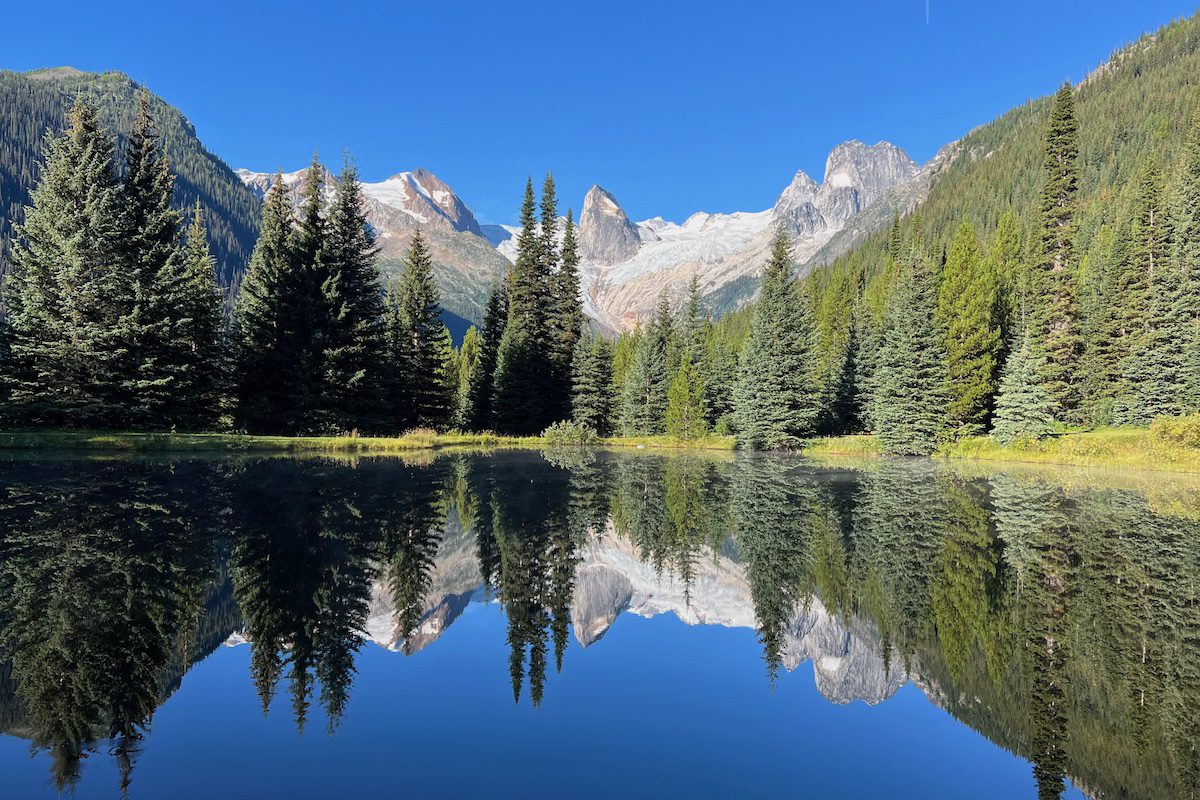
Lead image: Many women shrugged off their fears to navigate the Bugaboos / Photo by Claudia Laroye
Following in the footsteps of courageous women explorers
by Claudia Laroye
The sun is high, warming my shoulders on this late summer afternoon. I anchor my hiking pole into the rocks, tumbled over millennia by the long tongues of receding glaciers here in the Bugaboos, an impressive collection of gravity-defying granite spires, mountains and river valleys located in the Columbia Range of southeastern British Columbia. My female guide, Aleta Corbett, holds up a grey stone studded with sparkling stones. “Pryrite. Fool’s gold,” she says, noting this region was once crawling with prospectors eager to strike it rich, but finding a ‘bugaboo’, a dead end, for their efforts.
The miners and the European guides who explored this mountainous terrain in the Canadian Rockies were nearly always pipe-smoking, hardworking and sometimes hardscrabble men. But female adventurers have made their mark here, too. Trekking and exploring, blazing a trail for others to follow – women like Elizabeth Parker, co-founder of the Alpine Club of Canada, Mary Schäffer Warren, the first non-Indigenous person to visit and document Maligne Lake, and Elfi Grillmair, co-founder of CMH Heli Skiing.
They are among the pioneers who shrugged off intimidation and navigated the masculine outdoor adventure culture in the 19th and 20th centuries, paving the way for middle-aged hikers like me and my young hiking guide to follow in their footsteps. Their legacy is proof that if you can put one foot in front of the other, you’re a hiker, too.

Hiking for women: Trailblazing mountain mavens
Elizabeth Parker, Co-founder of the Alpine Club of Canada
Elizabeth Parker first encountered the breathtaking grandeur of the Canadian Rockies in the early part of the 20th century, visiting Banff and its therapeutic hot springs to take the waters. She returned to her home in Winnipeg, Manitoba, deeply enamoured with Canada’s mountain landscapes, and together with surveyor Arthur Wheeler, co-founded the Alpine Club of Canada (ACC) in 1906.
For Parker, the club was also essential for national pride, writing in the first volume of the Canadian Alpine Journal that: “The Canadian Rocky Mountain system, with its unnumbered and unknown natural sanctuaries for generations yet unborn, is a national asset. In time we ought to become a nation of mountaineers, loving our mountains with the patriot’s passion.”
Parker was an advocate for women mountaineers, and her involvement paved the way for women in the sport. In the club’s first year, 310 members joined, of which 77 were women. Within a decade, women made up half of the club’s membership.
The ACC has had an influential role in supporting environmentalism and public policy around Canada’s mountain parks. The ACC hut near Lake O’Hara in Yoho National Park is named in Parker’s honour.
Read More: 10 Best Hiking Trails in Canada for Women


Mary Schaeffer Warren, an original surveyor
American-born Mary Schäffer Warren was first drawn to the mountains alongside her husband, with whom she shared an interest in nature and science. After his death in 1903, she began extended travels in the Rockies, swapping long skirts for men’s breeches to more comfortably ride on horseback in the backcountry.
In 1907, Schäffer Warren and a like-minded friend, Mollie Adams, along with their guides, began an expedition to the headwaters of the Saskatchewan and Athabasca rivers. Schäffer Warren had heard about a “hidden” lake north of Brazeau Lake, in what is now Jasper National Park.
The lake is known to the Stoney-Nakoda peoples as Chaba Imne (Beaver Lake), and they, along with the Cree, had used the area for beaver trapping. While unsuccessful in locating the lake that year, the party returned in summer 1908 and found it. Schäffer Warren is widely recognized as the first non-Indigenous person to explore and document what is now known as Maligne Lake, considered one of Canada’s most spectacular and scenic bodies of water.
She claimed that “Lake Louise is a pearl; Lake Maligne is a whole string of pearls.”
Schäffer Warren surveyed the lake in 1911 at the request of the Geological Survey of Canada, a groundbreaking achievement as women were restricted from leading or participating in survey parties in the early 20th century.
Elfriede (Elfi) Grillmair, Co-founder of CMH Heli Skiing
Elfriede (Elfi) Grillmair, an adventurous Austrian-born woman, was one of the pioneering co-founders (with her then husband Leo and Hans Gmoser), and original business managers of British Columbia-based CMH Heli Skiing in 1965. Her love of the outdoors and endurance sports was well known. She once endured a gruelling 54-hour moped race across her homeland in the 1950s.
Celebrating 60 years this year, CMH is responsible for creating the heli-skiing industry in British Columbia as we know it today. Grillmair’s love of skiing and hiking, particularly in the Bugaboos, was matched by a passion for science, particularly geology, a field in which she made significant discoveries relating to gravitational theory and plate tectonics.

The Bugaboos as seen from CMH Bugaboos | Photo by Claudia Laroye

The spirit of adventure continues among women
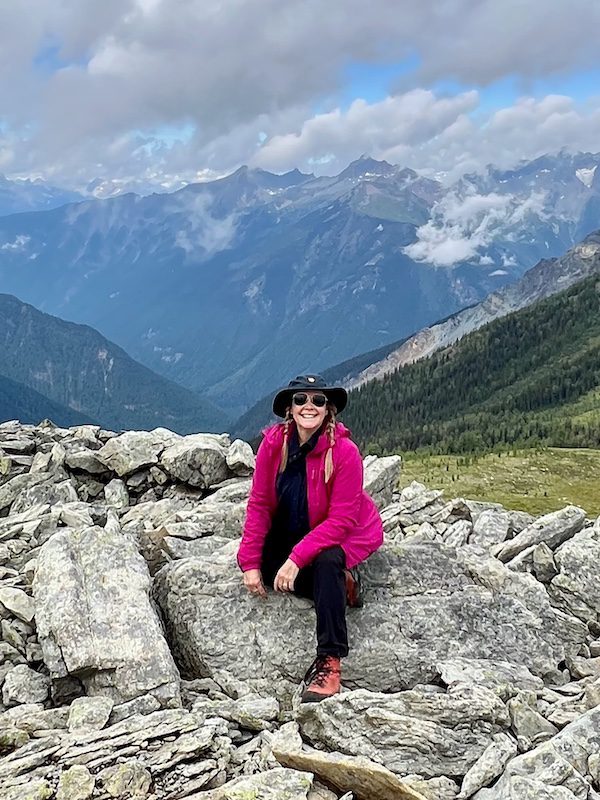
Back on what I’ve nicknamed the ‘pyrite pathway’ (for the countless rocks dotted with glittering iron ore), I contemplate that we’re the lucky ones, mining a golden vein of adventure in these mountains. I ask my guide, Aleta Corbett, what’s drawn her to guiding, apart from the chance to work amidst such extraordinary beauty.
Corbett came to guiding a bit later than most, inspired by her late brother, who was a ski guide and Rapattack (rapid attack) firefighter. “He would send me photos of his work, and I was in my cubicle thinking ‘someone’s doing something right,’” Corbett recalls.
Ready to shed corporate life, she ventured on the long path of accreditation and is in her seventh year of guiding hikers and skiers through the peaks of western Canada with CMH Heli Skiing and Summer Adventures. Corbett is one of several female guides on the roster at CMH Bugaboos this summer.
“Things are changing,” she notes. The outdoors are more welcoming to women than they once were, and through ACMG (Association of Canadian Mountain Guides), “there are way more female guides that are coming through and getting certifications. There are more women now than there probably ever has been.”
“I love guiding. You meet such cool and interesting people, and it’s neat to see them marvel at mountains they’ve never seen before.”
Returning to CMH Bugaboos by helicopter after our marvellous day in these magnificent mountains, I’m grateful to the pioneering women who forged the trail for girls of any age to explore, hike and seek a life in Canada’s incredible outdoors, which are anything but a dead end for the intrepid adventure seeker.
Disclaimer: Our writers are often invited by tourism boards and travel companies to experience places like this first hand so that they can share them with you. As a guest of CMH Bugaboos and Destination British Columbia, Claudia was not compensated by these companies for her time spent researching, planning and writing this feature, nor was JourneyWoman for publishing it. In addition, the host organizations did not review this article before it was published, a practice that allows the writer to express her perspective with integrity and candor.

More on Adventures in Canada
Claudia Laroye

Claudia Laroye is an award-winning freelance writer, author and content creator living in Vancouver, British Columbia. She writes about adventure, family, wellness and sustainable travel for a variety of online and print outlets around the world, including; Adventure, AFAR, CAA Magazine, Canadian Geographic, the Globe and Mail, Toronto Star, Vancouver Sun, Air Canada enRoute, NUVO Magazine, Saturday Evening Post, Explore, TIME Magazine, and the Vacay Canada network. Her award-winning travel anthology, ‘A Gelato a Day’ was published in fall 2022. Claudia is a member of the Society of American Travel Writers, the Travel Media Association of Canada and is a TTC Herald.
0 Comments
We always strive to use real photos from our own adventures, provided by the guest writer or from our personal travels. However, in some cases, due to photo quality, we must use stock photography. If you have any questions about the photography please let us know.
Disclaimer: We are so happy that you are checking out this page right now! We only recommend things that are suggested by our community, or through our own experience, that we believe will be helpful and practical for you. Some of our pages contain links, which means we’re part of an affiliate program for the product being mentioned. Should you decide to purchase a product using a link from on our site, JourneyWoman may earn a small commission from the retailer, which helps us maintain our beautiful website. JourneyWoman is an Amazon Associate and earns from qualifying purchases. Thank you!
We want to hear what you think about this article, and we welcome any updates or changes to improve it. You can comment below, or send an email to us at [email protected].